GOVERNMENT-CERTIFIED COURSE
50% OFF
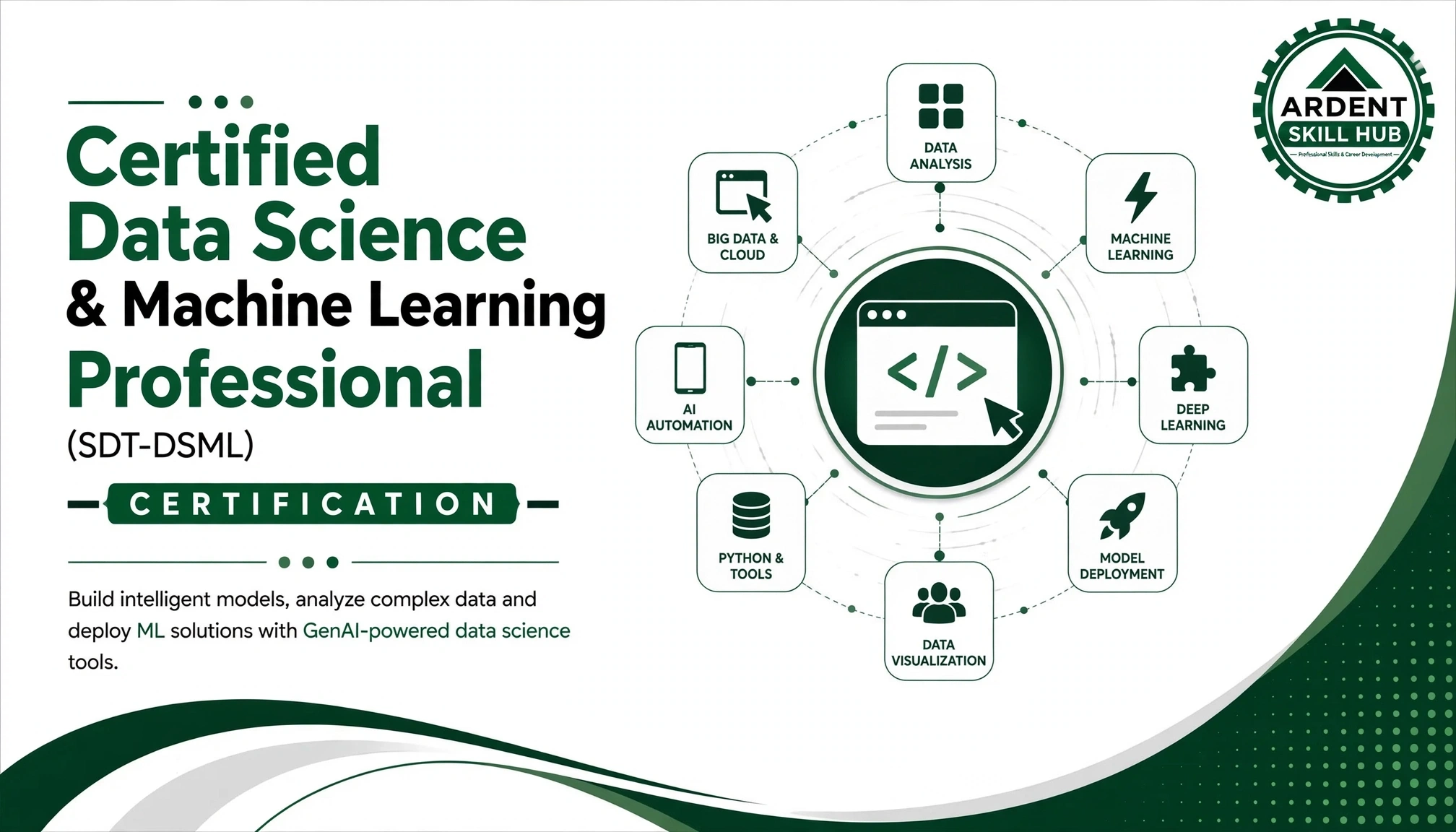
Ardent Certified-Data Intelligence-Data Science, Machine Learning & AI (DSML)
Build industry-ready expertise in Data Science, Machine Learning, and Artificial Intelligence through a practical, end-to-end learning experience. Master the complete data-to-model journey—from data collection, cleaning, exploration, and feature engineering to model development, evaluation, and deployment fundamentals. Work with real-world datasets and hands-on projects to develop the analytical, technical, and problem-solving skills needed for today’s data-driven careers.
₹40,000
₹20,000
Save ₹20,000
6 Months
Duration
Live +
Recorded
Max 30
Students
Govt.
Certified



Empowering learners with AI skills
to build a smarter tomorrow.
to build a smarter tomorrow.
Learning Outcomes
- Create meaningful visualizations and dashboards to communicate data-driven insights.
- Apply statistical and analytical techniques to support informed decision-making.
- Build and evaluate Machine Learning models using appropriate algorithms and performance metrics.
- Develop classification and regression solutions for practical prediction problems.
- Apply clustering techniques to discover hidden patterns and customer or data segments.
- Use AI and Machine Learning concepts to design solutions for real-world business and technology challenges.
- Complete end-to-end Data Science projects, from data preparation and exploration to model development and interpretation.
- Clean, explore, and prepare real-world datasets for modelling
- Build and evaluate regression, classification, and clustering models
- Deploy a simple ML model as a working demo application
Course Objectives
- Build practical fluency across the end-to-end machine learning workflow
- Develop the ability to select, train, and evaluate appropriate ML models for a given problem
- Understand the basics of deploying a model as a usable demo/application
- 4. Develop data visualization skills to communicate trends, patterns, and insights effectively.
- 5. Understand data preprocessing techniques, including handling missing values, data cleaning, and encoding.
- 6. Learn core Machine Learning concepts and understand how supervised and unsupervised learning work.
- 7. Build predictive models using algorithms such as Linear Regression, Logistic Regression, Decision Trees, and Random Forest.
- 8. Explore clustering and dimensionality reduction techniques such as K-Means, Hierarchical Clustering, and PCA.
- 9. Understand Artificial Intelligence concepts and their role in developing intelligent, data-driven solutions.
- 10. Develop practical problem-solving and project skills by applying Data Science, ML, and AI techniques to real-world datasets.
Applications in Industry
- Data analyst and junior data scientist entry-level roles
- Predictive analytics support in marketing, finance, and operations teams
- Foundation for postgraduate study or certification in AI/ML
- Business Intelligence & Analytics – Convert business data into actionable insights for strategic decision-making.
- Sales & Marketing Analytics – Analyze campaigns, customer trends, conversions, and marketing performance.
- Financial Analytics – Support risk analysis, forecasting, credit assessment, and financial decision-making.
- Healthcare Analytics – Analyze datasets to identify patterns and support data-driven healthcare solutions.
- Recommendation Systems – Use customer and product data to develop personalized recommendations.
- Operational Analytics – Improve processes, resource allocation, demand forecasting, and business efficiency.
- AI-Powered Applications – Apply Machine Learning and AI techniques to develop intelligent and automated solutions.
Frequently Asked Questions
The Data Intelligence, Data Science, Machine Learning & AI (DSML) program is a career-focused course designed to develop practical skills in Python, data analysis, visualization, Machine Learning, and AI.
The course is suitable for students, graduates, freshers, working professionals, and beginners who want to build a career in Data Science, Analytics, Machine Learning, or AI.
No. The program can be structured from the fundamentals, making it suitable for learners with basic or limited programming experience.
Python is the primary programming language used for data analysis, visualization, Machine Learning, and AI-related practical work.
Learners work with tools and libraries such as Python, NumPy, Pandas, Matplotlib, Seaborn, Scikit-learn, and Jupyter Notebook.
Yes. The program covers important Machine Learning techniques including Linear Regression, Logistic Regression, Decision Trees, Random Forest, K-Means, Hierarchical Clustering, and PCA.
Yes. Practical exercises and projects help learners apply Data Science, Machine Learning, and AI concepts to real-world datasets and business problems.
Learners can explore roles such as Data Analyst, Junior Data Scientist, Business Intelligence Analyst, Machine Learning Intern, Data Science Associate, and AI/ML Trainee.
Yes. The curriculum progresses from Python and data fundamentals to advanced analytics, Machine Learning, and AI, making it suitable for beginners as well as learners looking to strengthen existing skills.
The program develops a combination of technical, analytical, and problem-solving skills, along with practical project experience, helping learners prepare for data-driven roles across multiple industries.
Course Content — Modules
1
Module 1: Foundations of Data Science & the Data Intelligence Lifecycle
1
The Data Science Lifecycle, Fast: Problem to Insight
2
Hands-on Lab: Framing a Business Problem as a Data Science Task
3
Hands-on Lab: Setting Up Your Data Science Working Environment
2
Module 2: Python for Data Science
1
Python Essentials for Data Work: NumPy & Pandas at a Glance
2
Hands-on Lab: Loading & Manipulating a Real Dataset with Pandas
3
Hands-on Lab: Writing Your First Reusable Data-Processing Script
3
Module 3: Data Collection & Cleaning
1
Where Data Comes From & Why It's Always Messy
2
Hands-on Lab: Cleaning a Messy Real-World Dataset
3
Hands-on Lab: Handling Missing Values & Outliers
4
Module 4: Exploratory Data Analysis (EDA)
1
What to Look for in a New Dataset First
2
Hands-on Lab: Running a Full EDA Pass on a New Dataset
3
Hands-on Lab: Identifying Patterns & Anomalies Worth Investigating
5
Module 5: Data Visualization
1
Choosing the Right Chart for the Right Question
2
Hands-on Lab: Building a Visualization Dashboard from Scratch
3
Hands-on Lab: Turning Raw Charts into a Stakeholder-Ready Story
6
Module 6: Statistics & Probability for Data Science
1
The Stats You Actually Use Day to Day
2
Hands-on Lab: Running a Hypothesis Test on Real Data
3
Hands-on Lab: Calculating & Interpreting Confidence Intervals
7
Module 7: SQL & Databases for Data Analysis
1
Querying Data at the Source: SQL Essentials
2
Hands-on Lab: Writing Queries to Answer Real Business Questions
3
Hands-on Lab: Joining & Aggregating Data Across Multiple Tables
8
Module 8: Introduction to Machine Learning
1
What ML Actually Does: Supervised, Unsupervised & Beyond
2
Hands-on Lab: Training Your First Machine Learning Model
3
Hands-on Lab: Comparing Model Predictions Against a Baseline
9
Module 9: Supervised Learning: Regression
1
Predicting Numbers: Linear & Regularized Regression
2
Hands-on Lab: Building a Regression Model to Predict a Real Outcome
3
Hands-on Lab: Tuning Regularization to Reduce Overfitting
10
Module 10: Supervised Learning: Classification
1
Predicting Categories: Logistic Regression, Trees & KNN
2
Hands-on Lab: Building a Classification Model on Real Data
3
Hands-on Lab: Comparing Multiple Classifiers on the Same Dataset
11
Module 11: Model Evaluation & Validation
1
Accuracy Isn't Enough: Precision, Recall, ROC & Cross-Validation
2
Hands-on Lab: Evaluating a Model with the Right Metrics for the Problem
3
Hands-on Lab: Running K-Fold Cross-Validation on a Real Model
12
Module 12: Feature Engineering & Selection
1
Why Better Features Beat Better Algorithms
2
Hands-on Lab: Engineering New Features from Raw Data
3
Hands-on Lab: Selecting the Most Predictive Features & Re-Testing the Model
13
Module 13: Unsupervised Learning: Clustering & Dimensionality Reduction
1
Finding Structure Without Labels: Clustering & PCA
2
Hands-on Lab: Segmenting Data with K-Means Clustering
3
Hands-on Lab: Reducing Dimensions with PCA & Visualizing the Result
14
Module 14: Ensemble Methods
1
Why Combining Models Usually Wins: Bagging & Boosting
2
Hands-on Lab: Building a Random Forest Model
3
Hands-on Lab: Building & Tuning a Gradient Boosting Model
15
Module 15: Introduction to Deep Learning & Neural Networks
1
Neural Networks Explained Without the Heavy Math
2
Hands-on Lab: Building a Simple Neural Network from Scratch
3
Hands-on Lab: Training the Network & Tuning Basic Hyperparameters
16
Module 16: Computer Vision Basics
1
How Machines "See": Images, Pixels & CNNs at a Glance
2
Hands-on Lab: Building a Simple Image Classifier
3
Hands-on Lab: Using a Pretrained Model for Image Recognition
17
Module 17: Natural Language Processing Basics
1
How Machines Handle Text: Tokens, Embeddings & Basic NLP Tasks
2
Hands-on Lab: Building a Text Classifier (e.g. Sentiment Analysis)
3
Hands-on Lab: Extracting Key Information from a Batch of Text Data
18
Module 18: Time Series Analysis & Forecasting
1
What Makes Time Series Data Different
2
Hands-on Lab: Building a Forecasting Model on Real Time Series Data
3
Hands-on Lab: Evaluating Forecast Accuracy & Adjusting for Seasonality
19
Module 19: Introduction to Generative AI & LLMs
1
Where LLMs Fit Into the Data Science Toolkit
2
Hands-on Lab: Using an LLM API to Automate a Data Task
3
Hands-on Lab: Building a Simple Retrieval-Augmented Q&A Tool
20
Module 20: Model Deployment & MLOps Basics
1
Getting a Model from Notebook to Production
2
Hands-on Lab: Deploying a Model Behind a Simple API
3
Hands-on Lab: Monitoring a Deployed Model for Drift
21
Module 21: Big Data Tools & Cloud Platforms for ML
1
When Your Laptop Isn't Enough: Big Data & Cloud ML at a Glance
2
Hands-on Lab: Running a Data Pipeline on a Cloud Platform
3
Hands-on Lab: Training a Model on a Distributed/Cloud Environment
22
Module 22: Data Ethics, Bias & Responsible AI
1
Where Bias Enters a Model & Why It Matters
2
Hands-on Lab: Auditing a Model for Bias Across Subgroups
3
Hands-on Lab: Drafting a Responsible AI Checklist for a Project
23
Module 23: Building an End-to-End Data Science Portfolio Project
1
What a Hiring Manager Actually Looks for in a Portfolio
2
Hands-on Lab: Scoping & Starting Your Own End-to-End Project
3
Hands-on Lab: Getting Peer Review on Your Project Plan
24
Module 24: Capstone Project
1
Capstone Brief: Solving a Real Problem End-to-End with Data & ML
2
Hands-on Lab: Building, Training & Deploying the Complete Solution
3
Final Presentation & DSML Certification Review
 50% OFF
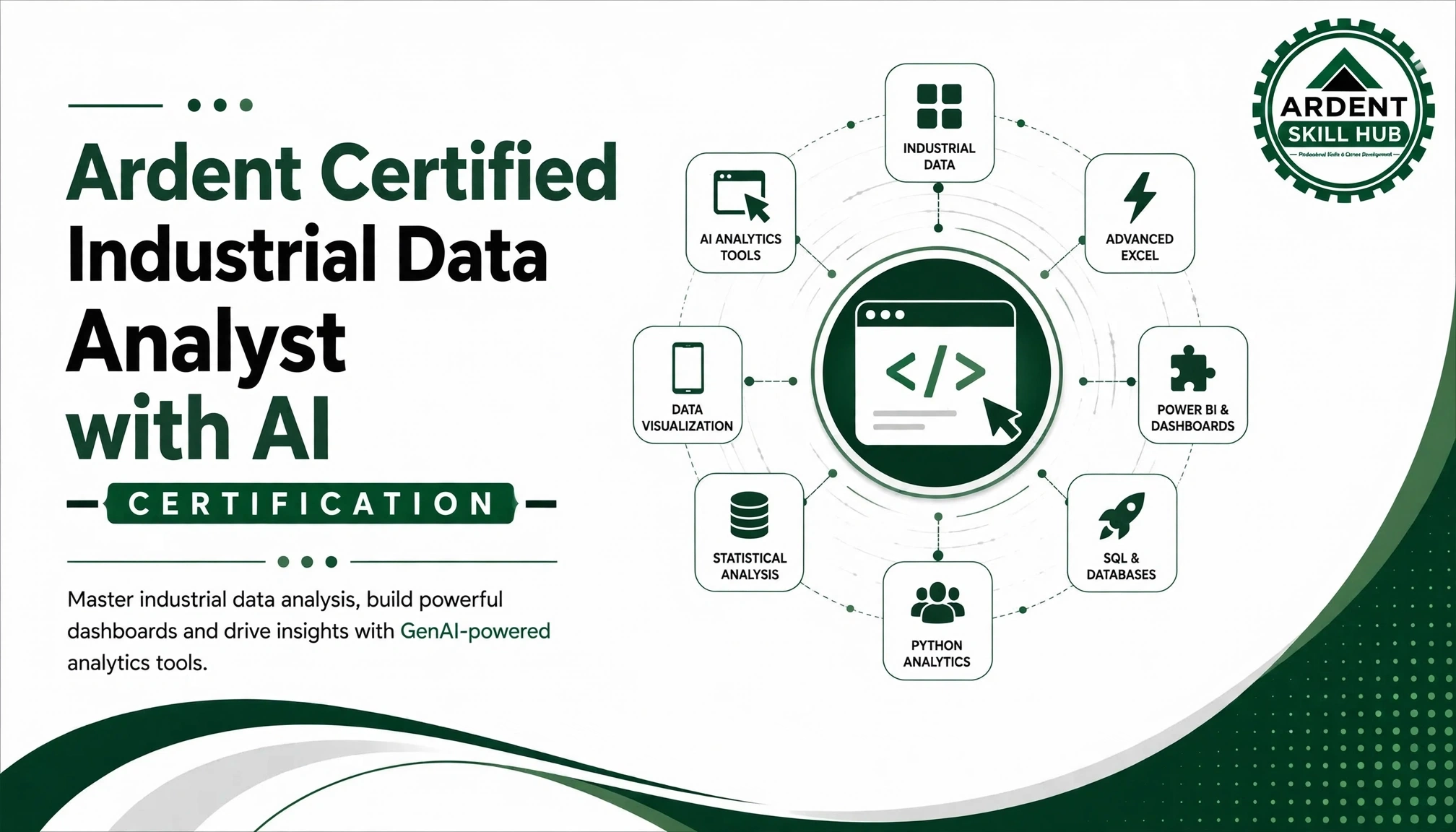
Ardent Certified AI-Powered Industrial Data Analyst — Advanced Excel, Power BI & Tableau (AIDA)
₹45,000
₹22,500
Save ₹22,500
 50% OFF
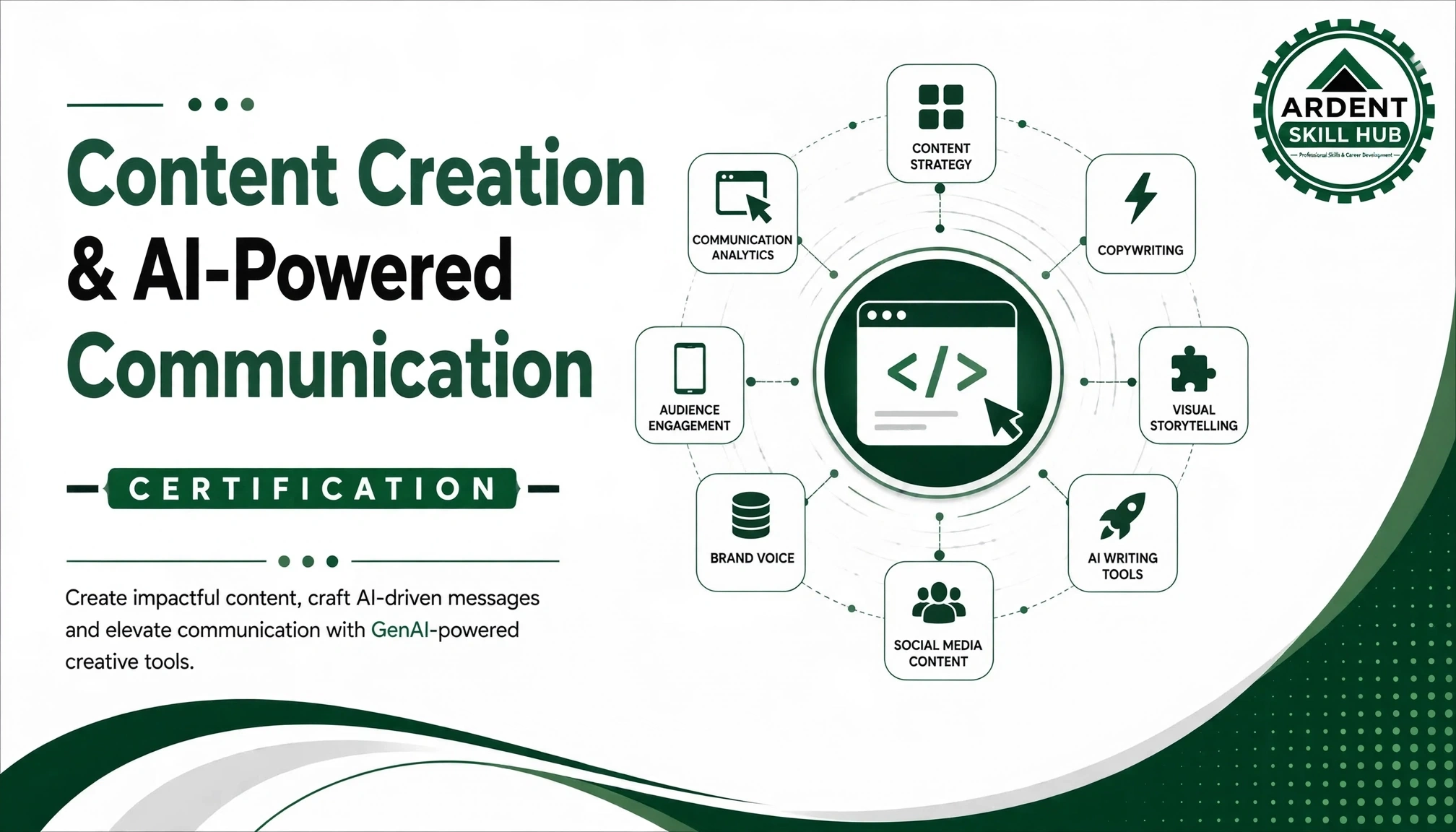
Ardent Certified-AI-Powered Content Creation, Communication & Office Automation (AICO)
₹52,000
₹26,000
Save ₹26,000
 50% OFF
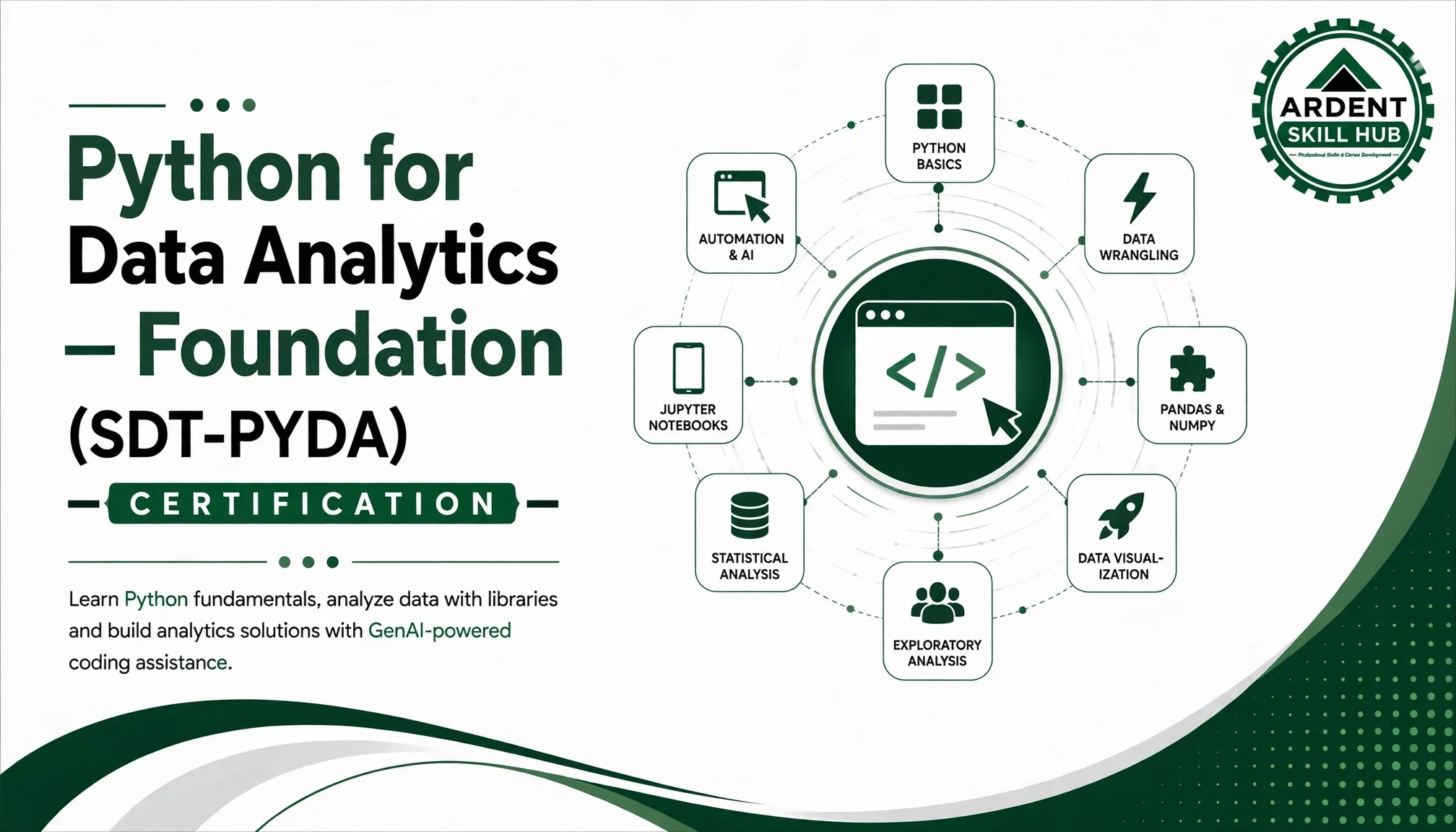
Ardent Certified-Python for Data Analytics & Data Science (PYDA)
₹45,000
₹22,500
Save ₹22,500
Course Delivery Format
Duration6 months (100 hours total)
ModeOnline Live Classes + Recorded Lectures
ScheduleWeekend & Weekday Evening Batches
Batch SizeMaximum 30 students
Prerequisites
- Laptop/Desktop with stable internet connection
- Basic English proficiency
- Willingness to dedicate 4–5 hours weekly
- No prior technical knowledge required
Investment & Scholarships
Course Fee
₹40,000
₹20,000
EMI OptionsAvailable
ScholarshipsMerit-based & Need-based
Early Bird15% Discount
Certification
- Course Completion Certificate
- Industry-recognized certifications
- LinkedIn badge
- Project completion certificates
Placement Support
- Resume building & LinkedIn optimization
- Mock interviews & soft skills training
- Access to job portal with 200+ partners
- Networking sessions with industry professionals
- Lifetime placement assistance
Learning Support
- 24/7 access to recorded lectures
- Doubt clearing sessions twice weekly
- Dedicated mentor support
- Peer learning community
- Monthly industry expert guest lectures